Note
Go to the end to download the full example code.
LDLT matrix inversion
This example demonstrates how to invert a matrix using the LDLT decomposition. It illustrates that an algorithm written for NumPy can be directly applied to APyTypes objects, which is useful for determining the required word length, testing, and verification of hardware implementations.
First, we define the LDLT decomposition and matrix inversion functions using NumPy arrays.
import matplotlib.pyplot as plt
import numpy as np

import apytypes as apy


def ldl_decomposition(
    A: np.ndarray | apy.APyFloatArray,
) -> tuple[np.ndarray | apy.APyFloatArray, np.ndarray | apy.APyFloatArray]:
    """
    LDL^T decomposition without pivoting.
    A must be square and symmetric.
    Returns L (unit lower-triangular) and D (diagonal stored as 1D array).
    """
    n = A.shape[0]

    if A.ndim != 2 or A.shape[0] != A.shape[1]:
        raise ValueError("A must be a square matrix.")

    # Symmetry check with plain loops (no np.allclose)
    for i in range(n):
        for j in range(i + 1, n):
            if abs(float(A[i, j] - A[j, i])) > 1e-12:
                raise ValueError("A must be symmetric for LDL^T decomposition.")

    if isinstance(A, apy.APyFloatArray):
        # Use APyTypes arrays for storage/results
        L = apy.zeros_like(A)
        D = apy.zeros(n, exp_bits=A.exp_bits, man_bits=A.man_bits, bias=A.bias)
    else:
        # Use numpy arrays only for storage/results
        L = np.zeros((n, n), dtype=float)
        D = np.zeros(n, dtype=float)

    for i in range(n):
        if isinstance(A, apy.APyFloatArray):
            L[i, i] = apy.fp(1.0, exp_bits=A.exp_bits, man_bits=A.man_bits, bias=A.bias)
        else:
            L[i, i] = 1.0

    for j in range(n):
        # D[j] = A[j,j] - sum_{k=0..j-1} L[j,k]^2 * D[k]
        s = 0.0
        for k in range(j):
            s += L[j, k] * L[j, k] * D[k]
        D[j] = A[j, j] - s

        if abs(D[j]) < 1e-15:
            raise np.linalg.LinAlgError(
                "Zero (or near-zero) pivot encountered in D; matrix may be singular "
                "or pivoting is required."
            )

        # L[i,j] = (A[i,j] - sum_{k=0..j-1} L[i,k]L[j,k]D[k]) / D[j], for i>j
        for i in range(j + 1, n):
            s = 0.0
            for k in range(j):
                s += L[i, k] * L[j, k] * D[k]
            L[i, j] = (A[i, j] - s) / D[j]

    return L, D


def inverse_from_ldl(
    A: np.ndarray | apy.APyFloatArray,
) -> np.ndarray | apy.APyFloatArray:
    """
    Invert A using LDL^T decomposition and triangular solves:
    A = L D L^T
    A^{-1} columns are solutions of A x = e_i.
    """
    L, D = ldl_decomposition(A)
    n = A.shape[0]
    if isinstance(A, apy.APyFloatArray):
        Ainv = apy.zeros_like(A)
    else:
        Ainv = np.zeros((n, n), dtype=float)

    for col in range(n):
        # e_col
        e = np.zeros(n, dtype=float)
        e[col] = 1.0

        # Solve L z = e (forward substitution)
        if isinstance(A, apy.APyFloatArray):
            z = apy.zeros(n, exp_bits=A.exp_bits, man_bits=A.man_bits, bias=A.bias)
        else:
            z = np.zeros(n, dtype=float)
        for i in range(n):
            if isinstance(A, apy.APyFloatArray):
                s = apy.fp(0.0, exp_bits=A.exp_bits, man_bits=A.man_bits, bias=A.bias)
            else:
                s = 0.0
            for k in range(i):
                s += L[i, k] * z[k]
            z[i] = e[i] - s  # since diag(L)=1

        # Solve D y = z (diagonal solve)
        if isinstance(A, apy.APyFloatArray):
            y = apy.zeros(n, exp_bits=A.exp_bits, man_bits=A.man_bits, bias=A.bias)
        else:
            y = np.zeros(n, dtype=float)
        for i in range(n):
            if abs(D[i]) < 1e-15:
                raise np.linalg.LinAlgError("Singular diagonal entry in D.")
            y[i] = z[i] / D[i]

        # Solve L^T x = y (back substitution)
        if isinstance(A, apy.APyFloatArray):
            x = apy.zeros(n, exp_bits=A.exp_bits, man_bits=A.man_bits, bias=A.bias)
        else:
            x = np.zeros(n, dtype=float)
        for i in range(n - 1, -1, -1):
            s = 0.0
            for k in range(i + 1, n):
                s += L[k, i] * x[k]  # L^T[i,k] = L[k,i]
            x[i] = y[i] - s  # diag(L^T)=1

        # Put solution as column `col`
        for i in range(n):
            Ainv[i, col] = x[i]

    return Ainv
Define a symmetric positive definite matrix and compute its inverse using NumPy for reference.
Ideally one should run over a range of matrices, but for demonstration purposes we will use a single matrix here.
A = np.array([[4.0, 1.0, 1.25], [1.0, 3.0, -2.5], [1.25, -2.5, 5.0]], dtype=float)

reference = np.linalg.inv(A)
numpy_ldlt = inverse_from_ldl(A)

error_numpy = np.linalg.norm(numpy_ldlt - reference)
Now we will test the LDLT inversion using APyTypes with various configurations of exponent bits, mantissa bits, and bias offsets.
man_bits_range = range(10, 41, 2)
exp_bits_range = range(2, 5)
bias_offset_range = range(-2, 3)
no_man_bits = len(man_bits_range)
no_exp_bits = len(exp_bits_range)
no_bias_offsets = len(bias_offset_range)
error_apytypes = np.empty((no_exp_bits, no_man_bits, no_bias_offsets), dtype=float)
exp_bits_apytypes = np.empty((no_exp_bits, no_man_bits, no_bias_offsets), dtype=int)
man_bits_apytypes = np.empty((no_exp_bits, no_man_bits, no_bias_offsets), dtype=int)
bias_offsets_apytypes = np.empty((no_exp_bits, no_man_bits, no_bias_offsets), dtype=int)
print("Starting APyTypes LDLT inverse tests...")
for i, exp_bits in enumerate(exp_bits_range):
    for j, man_bits in enumerate(man_bits_range):
        for k, bias_offset in enumerate(bias_offset_range):
            standard_bias = (1 << (exp_bits - 1)) - 1
            bias = standard_bias + bias_offset
            apy_A = apy.fp(A, exp_bits=exp_bits, man_bits=man_bits, bias=max(bias, 0))
            apy_ldlt = inverse_from_ldl(apy_A)
            error_apytypes[i, j, k] = np.linalg.norm(apy_ldlt.to_numpy() - reference)
            exp_bits_apytypes[i, j, k] = exp_bits
            man_bits_apytypes[i, j, k] = man_bits
            bias_offsets_apytypes[i, j, k] = bias_offset
Starting APyTypes LDLT inverse tests...
/home/runner/work/apytypes/apytypes/examples/ldlt_matrix_inversion.py:168: RuntimeWarning: invalid value encountered in subtract
  error_apytypes[i, j, k] = np.linalg.norm(apy_ldlt.to_numpy() - reference)
Plot the errors for different configurations of exponent bits, mantissa bits, and bias offsets
fig, ax = plt.subplots()
linestyles = ["-", "--", ":"]
for i, exp_bits in enumerate(exp_bits_range):
    for j, bias_offset in enumerate(bias_offset_range):
        vals = error_apytypes[i, :, j]
        if np.isnan(vals).any():  # Check for NaN values
            print(
                f"Skipping plot for exp_bits={exp_bits}, bias_offset={bias_offset} due to NaN values."
            )
        else:
            ax.plot(
                man_bits_range,
                vals,
                linestyle=linestyles[i % len(linestyles)],
                color=f"C{j}",
                label=f"exp_bits={exp_bits}, bias_offset={bias_offset}",
            )
ax.set_xlabel("Mantissa bits")
ax.set_ylabel("Error (L2 norm)")
ax.set_title("Error of LDLT matrix inversion with APyTypes")
ax.set_yscale("log")
ax.legend()
plt.show()
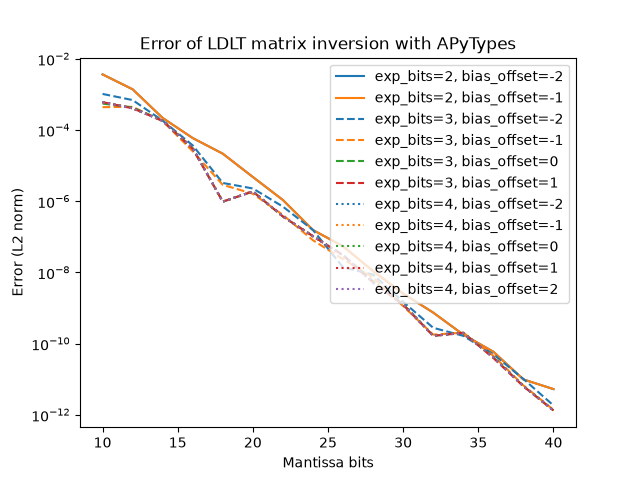
Skipping plot for exp_bits=2, bias_offset=0 due to NaN values.
Skipping plot for exp_bits=2, bias_offset=1 due to NaN values.
Skipping plot for exp_bits=2, bias_offset=2 due to NaN values.
Skipping plot for exp_bits=3, bias_offset=2 due to NaN values.
Total running time of the script: (0 minutes 0.210 seconds)